

Component 01
Rework Tax
Work redone after priorities shift, direction conflicts, or requirements remain unclear.
Delayed decisions, rework, turnover and missed commitments are easier to address when you can name the pattern. Start with the free 15-item Culture Tax assessment to identify an area worth examining. Then use Culture Tax Calculator Lite to explore operating-cost assumptions separately.
The assessment identifies patterns. Calculator outputs depend on your inputs and assumptions; they are not an audit or a verified measure of financial loss.
Complete the 15-item assessment to receive the live Culture Tax Calculator Lite link. The sheet models six recurring costs against annual operating expenses using planning assumptions, not your assessment score.
Work redone after priorities shift, direction conflicts, or requirements remain unclear.
Attrition, recruiting and ramp-up, lost knowledge, and disengagement reduce the capacity a team has built.
Slow approvals, escalations, re-litigated decisions, and unclear ownership hold work in place.
Status meetings, handoffs, and cross-team alignment consume time needed for the work itself.
Ideas stall or get killed by misalignment, while the organization responds slowly to change.
Missed commitments, slipping timelines, and stalled initiatives keep plans from becoming results.
These are the existing directional assumptions in Culture Tax Calculator Lite, expressed as a share of annual operating expenses. The assessment identifies a focus category; its score does not produce these estimates.
20–41% of annual OpEx
Component costs may overlap and should not automatically be treated as additive or as independently verified losses. Calculator outputs depend on your inputs and assumptions; they are not an audit or a verified measure of financial loss.
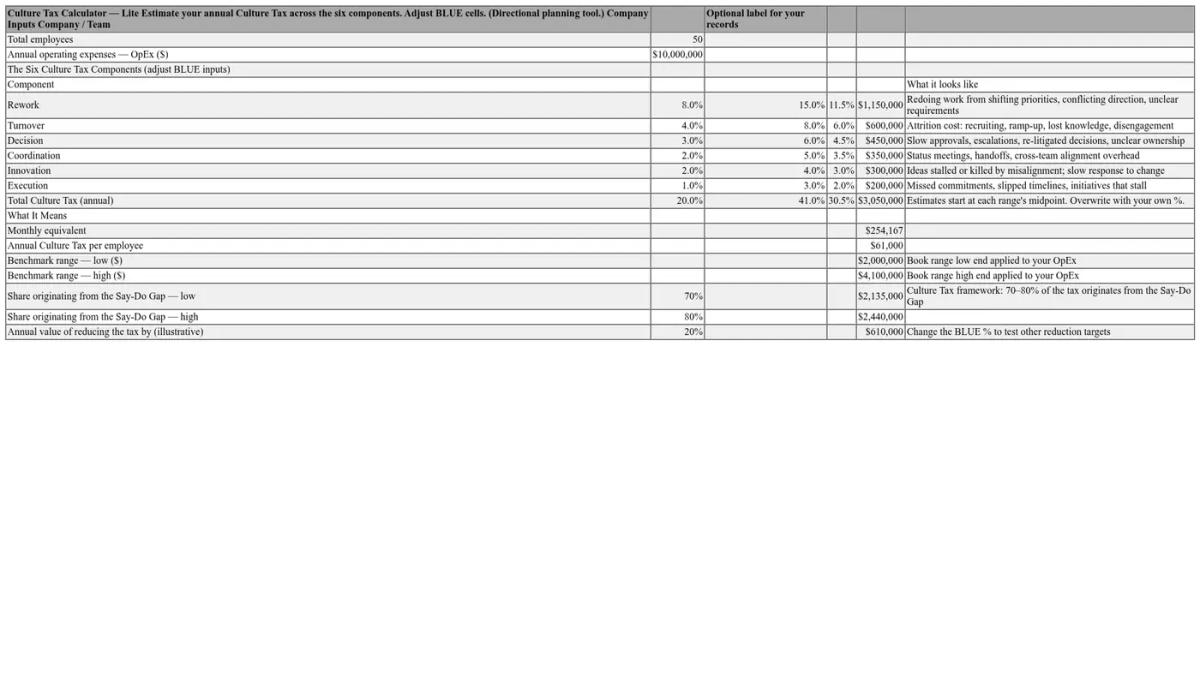
Complete the Culture Tax assessment to receive the Culture Tax Calculator Lite link with your results. In the sheet, enter your headcount and annual OpEx, then adjust the blue cells to explore its planning assumptions and prepare a more specific leadership conversation.
The assessment identifies a category to examine first. It does not turn a checkbox score into a financial estimate.
Identify a pattern and explore broad operating-cost assumptions.
Take the Free AssessmentOrganize workforce inputs and examine cost drivers and scenarios in a more detailed workbook.
View the Executive CalculatorGet personal help applying changes to a current leadership challenge.
Provided by JEM Premier Coaching. No tool purchase is required to seek coaching.
Explore coachingA useful starting point connects what people experience with the costs leaders can examine. The assessment and Culture Tax Calculator Lite do different jobs, so your next decision rests on the right inputs.
Answer 15 questions across Rework Tax, Turnover Tax, Decision Tax, Coordination Tax, Innovation Tax, and Execution Tax. Your result shows a focus category, or a shared focus if scores tie.
Enter headcount and annual operating expenses in Culture Tax Calculator Lite. Its six editable component assumptions create a separate directional planning estimate.
Use the pattern and the operating numbers to decide which ownership, decision, coordination, or execution practices to examine first.
“Culture is the operating system that determines whether strategy works. When it's fragmented, performance leaks. When it's engineered, performance compounds.”

Leadership Coach. Certified Workplace Coach. SAFe Practitioner Expert.
Jim Marsh, Managing Principal of JEM Premier Coaching LLC, helps executives build high-performing cultures, resilient teams, and leaders who deliver results in fast-changing environments. He partners with senior leaders to design practical Culture Operating Systems that drive engagement, accountability, and performance across their organizations.
With deep experience across logistics, pharma, telecom, and tech, Jim has led major transformations, including large-scale Agile and product-model adoptions with 100% customer satisfaction. A certified Expert Coach, Workplace Coach, Lean Expert, and SAFe practitioner, he has published widely, spoken internationally, and now brings executive insight and coaching discipline to organizations that want culture to be a competitive advantage.